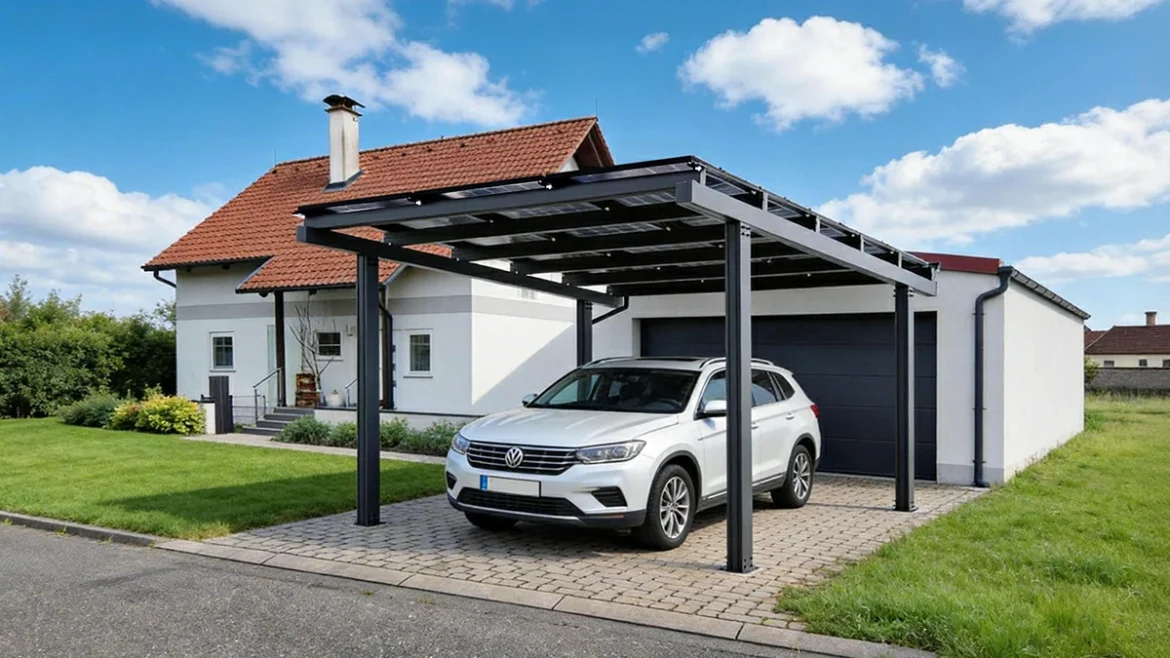
Steel rusts, wood swells – and aluminium? It simply stays what it is. Once you have installed an aluminium solar carport, you'll quickly wonder why you ever considered anything else. This guide explains step by step what makes this material so compelling – without technical jargon.
What exactly is an aluminium solar carport?
A solar carport is essentially a covered parking space for your car – except that the roof is not made of shingles or foil, but of solar panels that generate electricity for you every day. The supporting frame beneath – the actual structure – can be made from various materials. By far the most popular choice for private homes today is aluminium.
The aluminium structure serves two purposes simultaneously: it holds the solar panels stably in the correct orientation towards the sun – and at the same time protects your vehicle from rain, hail and snow.
Why aluminium? The key advantages at a glance
Before we dive into the details, here is a brief overview of the key strengths of this material:
Aluminium does not rust – even after 30 years outdoors the surface remains intact.
Three times lighter than steel – less foundation required, easier installation, lower structural demands.
No painting, no impregnating, no retreating – once installed, simply forget about it.
At the end of its service life, aluminium is melted down and reused with virtually no loss.
Reinforced profiles withstand snow loads up to 1.2 kN/m² and wind loads up to 140 km/h.
Powder-coated in any RAL colour – the carport adapts to your home, not the other way around.
No rust, no peeling paint – why aluminium is superior to other materials
Anyone who has seen a steel carport after ten years knows the picture: rust spots at the welds, peeling protective paint, touch-ups that no longer adhere properly. This is not a quality defect – it is simply the nature of the material. Steel oxidises on contact with moisture. And no matter how well it is coated: water always finds a way in somewhere.
Wood has its own charm, but is equally high-maintenance: regular oiling, painting or glazing is a must, otherwise the material shrinks and cracks. Especially in regions with alternating humid climates – which covers most of Germany, Austria and Switzerland – wood is not an ideal choice for permanently cantilevered structures.
Aluminium simply does not have these problems. The surface remains smooth, dimensional stability is maintained, and load-bearing capacity does not decrease over decades. A maintenance-free aluminium solar carport frame system is literally installed once and then forgotten – in the best sense of the word.

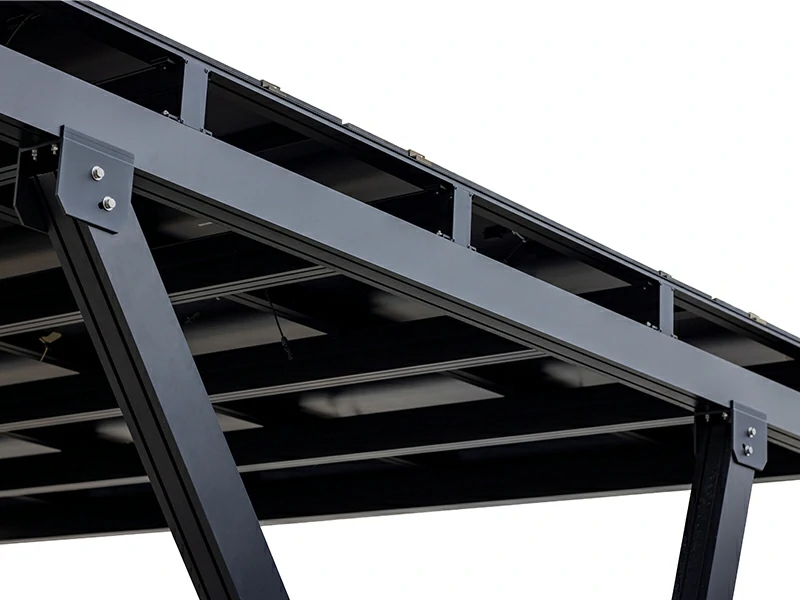
Fig.: Anodised aluminium connection profile – corrosion-resistant, dimensionally stable, no maintenance required.
Solar carport with reinforced aluminium structure – what does that mean in practice?
Not all aluminium carports are the same. There is a wide range on the market – from inexpensive kit systems to professional solar carports with reinforced aluminium structures. What exactly does this mean in practice?
Profile thickness and cross-sectional shape
High-quality systems use extruded aluminium profiles with wall thicknesses of 2 to 4 millimetres. The cross-sectional shape – whether rectangular, double-T or hollow chamber – is crucial for rigidity. Good manufacturers have load-bearing calculations checked by independent structural engineering firms and document the values in the data sheet.
Snow load and wind zone
In Germany and Switzerland, specific standards apply for snow and wind loads (DIN EN 1991, SIA 261). A reinforced aluminium frame system is dimensioned to meet the load assumptions for your specific location – not just the average, but for the relevant load zone. Always ask for proof of compliance when purchasing.
Bolted connections vs. welds
Modern aluminium carport systems are not welded, but bolted and slotted together. Bolted connections are controllable, can be retightened and are repairable. Welds, on the other hand, create thermal stresses and often require post-treatment to ensure corrosion protection.
Easier to install: aluminium is kind to your foundations
Aluminium at a glance
| Density | 2.7 g/cm³ |
| vs. Steel | 3× lighter |
| Corrosion | none |
| Recyclable | ~100% |
| Service life | 30+ years |
| Maintenance | none |
The low weight of aluminium has a practical advantage that many homeowners initially underestimate: the foundation. Choosing a heavier material means more concrete, deeper foundations and potentially more expensive earthworks. An aluminium carport can often be anchored on simple point foundations (so-called ground anchors or base plates) – saving time and money during installation.
Especially on sealed surfaces (paved areas, concrete floors), this is a decisive advantage. For some systems, grouted sleeve anchors are sufficient instead of an elaborate concrete base slab.

Fig.: Compact ground anchoring – less civil engineering, less effort, lower costs.
In the commercial sector, integrated cable management is a particularly important feature. Professional systems have aluminium profiles with internal hollow chambers through which all DC and AC cables are routed invisibly and protectedly – this also meets the requirements of the VDE standard for fixed installations.
Sustainability: aluminium and its environmental footprint
A frequently raised objection is: "Isn't the production of aluminium very energy-intensive?" That is correct – primary production from bauxite consumes a lot of electricity. But here comes the key point: aluminium is recyclable to almost 100%, and reprocessing requires only about 5% of the energy of new production.
In practice this means: a solar carport frame that has generated electricity for 30 years delivers a valuable raw material back into the cycle at the end of its life. The CO₂ footprint of the material is offset – together with the solar power generated – typically within just a few years.
Good manufacturers also rely on aluminium with a high recycled content (so-called "secondary aluminium") – this further significantly improves the environmental balance. Ask specifically about this when purchasing.
Installation: a finished carport in half a day
Another advantage that is often underestimated in everyday use is the ease of installation of aluminium systems. Since the profiles are already precisely cut and often pre-drilled at the factory, in many cases only a screwdriver and cordless drill are needed on site. Welding is completely unnecessary.
Typical installation time for a single carport (2 parking spaces, 8–10 modules): 4 to 8 hours with two tradespeople. Many suppliers deliver the kits with step-by-step instructions and an assembly video – however, the electrical connection must always be carried out by a licensed electrician.
Conclusion
An aluminium solar carport is not just a covered parking space with solar panels. It is a carefully thought-out, durable and sustainable energy investment – without follow-up costs from rust, paint or structural decay. Whether it stands in the garden of a private home or is used as a premium aluminium solar carport for commercial use: aluminium combines technical strength with aesthetic flexibility and an outstanding service life.
Choosing a maintenance-free aluminium solar carport frame system is a one-time decision – that lets you benefit from it for decades. That is the most honest summary we can give you.
Do you have specific questions about your project?
We advise you free of charge and without obligation – on location, size, structural engineering and subsidies.
Request a free quote now →