At midday, your solar panels often generate far more power than your household consumes – excess energy is fed back to the grid for just a few cents per kWh. Hours later, when your family returns home, the oven and washing machine run, yet your roof produces no solar power. Every kilowatt-hour must then be purchased from the grid at full retail price. This gap between solar generation and household demand is why more homeowners install battery storage. The key question is not whether storage makes technical sense – but at what point it delivers a positive financial return. Below we calculate the economics transparently using up-to-date 2026 market data.
Why Battery Storage Represents a Profitable Investment
Without a battery, most households only self-consume roughly 25 to 35 percent of their self-generated solar power – the rest is exported to the grid. With a correctly sized battery system, self-consumption rises to 60 to 80 percent. The logic is straightforward: every kilowatt-hour you use on-site avoids buying grid power at approximately 37 cents/kWh (average residential electricity price in Germany, 2026 BDEW analysis). That same kilowatt-hour exported only earns 7.78 cents/kWh (feed-in tariff for systems up to 10 kWp, valid February–July 2026). The ~29 cent per kWh difference is the core driver behind every storage system’s profitability.
Practical Calculation Example: What Value Does a Battery Storage System Deliver?
Take a typical four-person household with 4,500 kWh annual consumption and an 8 kWp rooftop PV system (~950 kWh per kWp per year, generating roughly 7,600 kWh annually):
Without Battery Storage
- Self-consumption rate ~30% → 2,280 kWh used directly = €843.60 saved grid costs
- 70% exported → 5,320 kWh × 7.78 ct = €413.90 feed-in revenue
- Total annual financial benefit: €1,257.50
With an 8 kWh Battery Storage System
- Self-consumption jumps to ~62% (includes ~10% charge/discharge efficiency losses) → 4,674 kWh used directly or via battery = €1,729.38 saved grid costs
- Remaining 38% exported → 2,926 kWh × 7.78 ct = €227.60 feed-in revenue
- Total annual financial benefit: €1,956.98
Additional Annual Benefit From the Battery System
€1,956.98 − €1,257.50 = €699.48 per year, minus ~€60 annual running costs (insurance, remote monitoring) → ~€640 net annual saving
For a typical upfront investment of roughly €4,800 for an 8 kWh storage unit (battery price €450/kWh plus ~€1,200 installation fees, 2026 market levels), this results in a payback period of approximately 7.5 years. LFP battery cells have a service life of 15–20 years (6,000–10,000 charge cycles), leaving 8 to 12 years of pure savings after breaking even.
Calculate Your Own Payback With This Simple Formula
You don’t need to recalculate every quote manually – use this simplified formula to quickly evaluate any offer:
Total Battery Investment (€)
÷ [ (Extra Usable kWh Per Year × (Retail Electricity Price − Feed-In Tariff))
− Annual Running Costs (€) ]
Rule of thumb: If your calculated payback time sits under half the battery’s technical service life (roughly 8–10 years), the investment is clearly worthwhile.
Factors That Impact Profitability & Payback Timeline
1. Consumption Habits & Daily Load Profile
Households with high daytime power use (home offices, heat pumps, EV charging) already make good use of solar power without storage. Batteries deliver the strongest financial gain for homes with morning and evening demand peaks – standard for working families.
2. Correct Storage Sizing
The biggest economic gain comes from upgrading from no storage to a 5–10 kWh system. Every extra kWh of capacity beyond this delivers diminishing returns, as batteries rarely fully recharge on low-sunlight winter days. General guideline: 1 to 1.5 kWh of storage per 1 kWp of installed solar capacity.
3. Charge & Discharge Efficiency Losses
Modern LFP lithium batteries achieve a round-trip efficiency of roughly 90%. This means out of 10 kWh stored, only around 9 kWh are available for household use. Any credible payback calculation must account for this ~10% energy loss – suppliers quoting 100% efficiency skew results artificially.
4. Ongoing Maintenance & Operating Expenses
Budget a realistic €50–80 per year for insurance, remote monitoring and occasional servicing. Batteries require replacement after 15–20 years. Storage prices are projected to fall a further 5–15% over the next 12–18 months, meaning future replacements will cost less than your initial purchase.
5. Electricity Price & Subsidy Trends
By law, feed-in tariffs drop 1% every six months under §49 of the German EEG 2023 – falling to 7.71 ct/kWh starting August 2026. Residential retail electricity prices remain high at 32–38 ct/kWh. The widening gap between falling export rates and expensive grid power makes self-consumption – and battery storage – more attractive each year.
Who Should Install Battery Storage – And Who Should Not?
Battery storage is not a one-size-fits-all solution. Use this honest comparison to assess your personal situation:
✓ Ideal Candidates
- Power demand concentrated in mornings and evenings (families, working households)
- Electric vehicle or heat pump already fitted or planned
- Annual energy consumption of at least ~3,500 kWh
- South / east-west oriented roof with strong sunlight, minimal shading
- Planning to live in the property for 10+ years
- Existing PV system nearing the end of its feed-in tariff term
✗ Poor Fit
- Very low annual power usage (below ~2,500 kWh)
- All consumption concentrated entirely during daylight hours (e.g. full-time home office with no evening demand)
- Heavily shaded roof leading to low solar yield
- Planning to move or sell the property within 3–5 years
- Tight budget where the PV system alone already hits financial limits
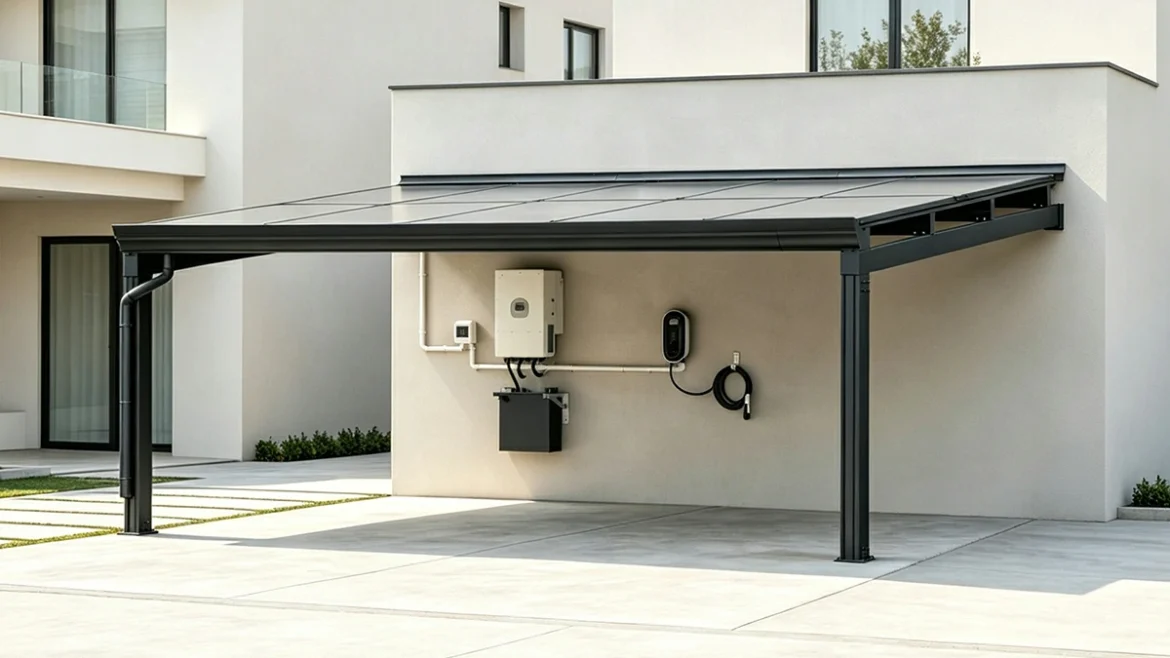
Real-World Case Study: Aluminum Solar Carport With Battery Storage & EV Charger by Ecosolarcarport
One of Ecosolarcarport’s most frequent customer enquiries combines an aluminum solar carport, battery storage and home EV charging station – without taking up valuable rooftop space on your house. Below is the economic breakdown for a typical setup:
- Carport solar capacity: 6 kWp → ~5,700 kWh annual solar generation
- Household power use: 4,500 kWh + EV charging demand of ~3,000 kWh per year (~15,000 km driven)
- 8 kWh battery + intelligent load management (prioritizes EV charging with solar surplus)
- Achievable self-consumption rate: ~75%, thanks to the large, controllable EV load
- On-site self-consumed power: 4,275 kWh × 37 ct = €1,581.75 grid cost savings
- Surplus exported to grid: 1,425 kWh × 7.78 ct = €110.87
- Total annual financial benefit: ~€1,692.60
Total upfront investment (carport frame, 6 kWp PV panels, 8 kWh storage, EV charger, full installation): roughly €15,000–16,000. Payback period: ~9 years. This calculation does not include additional savings from eliminating petrol costs or public EV charging fees.
The core advantage of the carport concept: your home roof remains free for other uses or can accommodate a separate second PV array. At the same time, the carport shelters your vehicle, patio or parking space from harsh weather.
Three Common Myths About Solar Battery Storage
- “A battery makes me fully off-grid.” In practice, retaining a grid connection remains practical and usually mandatory – especially in winter, when solar generation and battery capacity cannot cover full demand. 100% self-sufficiency is rarely economically viable using battery storage alone.
- “A larger battery delivers better returns.” Often the opposite is true: oversized batteries rarely fully charge through winter and unnecessarily extend your payback period. Correct sizing matters far more than maximum capacity.
- “Batteries never make financial sense.” This outdated belief comes from the era of storage prices around €1,900/kWh (2015). With today’s 2026 pricing of €350–500/kWh, the economics have completely transformed.
Quick Reference Table: Correct Storage Sizing Guidelines
| Solar System Capacity | Recommended Battery Size | Typical Household Profile |
|---|---|---|
| 3–5 kWp | 3–5 kWh | 1–2 people, low energy consumption |
| 6–8 kWp | 6–10 kWh | 3–4 people, average power usage |
| 9–12 kWp | 10–15 kWh | Family home with heat pump or electric vehicle |
| 13+ kWp | 15–20 kWh | Large residence, combined carport + EV charging setup |
Rule of thumb: 1–1.5 kWh of storage per 1 kWp of installed solar power. Minor individual adjustments based on your unique consumption pattern are normal and often beneficial.
Full Overview: All Key Benefits of Solar Battery Storage
- Higher self-consumption: Far more of your self-generated solar power is used on-site instead of exported at low rates
- Protection against electricity price volatility: A large portion of your energy demand becomes stable and predictable long-term
- Compatible with EVs and heat pumps: Absorbs large power demand spikes without straining the public grid
- Optional backup power function: Bridges short grid outages (depends on system configuration, additional cost €300–2,000)
- Higher property value: PV systems paired with battery storage are seen as a premium home feature on the real estate market
- 20-year planning security: Paired with legally guaranteed feed-in tariff income